Black Herald Press participe au 35e Marché de la Poésie, du mercredi 7 au dimanche 11 juin 2017, place Saint-Sulpice (Paris VIe), stand 710 (parvis de l’église), en compagnie des Carnets d’Eucharis & du Visage Vert.

Posted by Paul Stubbs on June 6, 2017
https://blackheraldpressblog.wordpress.com/2017/06/06/marche-de-la-poesie/
Berkeley Books of Paris 8, rue Casimir Delavigne 75006 Paris http://www.facebook.com/BBoParis
Books displayed:
Ex Nihilo, Paul Stubbs (Black Herald Press, 2010)
Flesh, Paul Stubbs (Black Herald Press, 2013)
The End of the Trial of Man, Paul Stubbs (Arc Publications, 2015)

Posted by Paul Stubbs on May 23, 2015
https://blackheraldpressblog.wordpress.com/2015/05/23/black-herald-press-at-the-berkeley-books-of-paris/
The Ages of Life
You cities of Euphrates,
You streets at Palmyra,
You forests of pillars in the desert plain,
What are you?
Your crests, as you passed beyond
The bounds of those who breathe,
By smoke of heavenly powers and
By fire were taken away;
But now I sit beneath clouds, in which
Peculiar quiet comes to each one, beneath
A pleasing order of oak-trees, on
The heath where the roe-deer feed, and strange
To me, remote and dead seem
The souls of the blessèd.
Friedrich Hölderlin
From Selected Poems and Fragments
(translated from the German by Michael Hamburger – Penguin Classics, 1998)
***
Lebensalter
Ihr Städte des Euphrats !
Ihr Gassen von Palmyra !
Ihr Säulenwälder in der Eb’ne der Wüste,
Was seid ihr?
Euch hat die Kronen,
Dieweil ihr über die Gränze
Der Othmenden seid gegangen,
Von Himmlischen der Rauchdampf und
Hinweg das Feuer genommen;
Jezt aber siz’ ich unter Wolken, darin
Ein jedes eine Ruh’ hat eigen, unter
Wohleingerichteten Eichen, auf
Der Heide des Rehs, und fremd
Erscheinen und gestorben mir
Der Seeligen Geister.
*
Posted by Paul Stubbs on May 22, 2015
https://blackheraldpressblog.wordpress.com/2015/05/22/you-cities-of-euphrates-you-streets-at-palmyra/
Le 33e Marché de la poésie se déroulera place Saint-Sulpice, Paris VIe, du mercredi 10 à partir de 14h au dimanche 14 juin 2015. Black Herald Press sera sur le stand 710, en compagnie de la Dernière Goutte et des Carnets d’Eucharis.

http://poesie.evous.fr/Liste-des-participants-au-33e-Marche-de-la-Poesie.html

Marché de la poésie 2014.
Posted by Paul Stubbs on May 22, 2015
https://blackheraldpressblog.wordpress.com/2015/05/22/33e-marche-de-la-poesie-paris-du-10-au-14-juin-2015/

Dits des xhuxha’i
ANNE-SYLVIE SALZMAN
Tales of the xhuxha’i
bilingual book
translated from the French by the author
recueil bilingue
Black Herald Press, mai 2015
58 pages – 9 € – ISBN 978-2-919582-11-2
à paraître / forthcoming
To pre-order the book
blackheraldpress.wordpress.com/buy-our-titles/
Posted by Paul Stubbs on April 14, 2015
https://blackheraldpressblog.wordpress.com/2015/04/14/dits-des-xhuxhai-tales-of-the-xhuxhai-anne-sylvie-salzman/
Cosmographia
COSMOGRAPHIA
& other poems
BLANDINE LONGRE
with an introduction by Paul Stubbs
Black Herald Press, may 2015
70 pages – 9 € – ISBN 978-2-919582-10-5
To pre-order the book
blackheraldpress.wordpress.com/buy-our-titles/
about Clarities, the author’s previous collection
blackheraldpress.wordpress.com/books/clarities-blandine-longre/
Posted by Paul Stubbs on April 14, 2015
https://blackheraldpressblog.wordpress.com/2015/04/14/forthcoming-cosmographia-by-blandine-longre/
 “in end-times, when Hell is certain, and
Eliot, not Christ, he rots back onto the
grass…”
Paul Stubbs, ‘Death of Utopia’
(After A Piece of Waste Land, Francis Bacon, 1982)
The poem & its French translation:
http://blongre.hautetfort.com/archive/2014/08/25/mort-de-l-utopie-paul-stubbs-5433565.html
Posted by Paul Stubbs on September 21, 2014
https://blackheraldpressblog.wordpress.com/2014/09/21/death-of-utopia-paul-stubbs/
 “Ne cherchons pas à comprendre. Comprendre est le plus souvent en art un jeu puéril et naïf, l’aveu d’une sensibilité ralentie, la revanche intellectuelle du spectateur affligé d’anesthésie artistique. Celui qui ne comprend pas et s’obstine à comprendre est, à priori, celui qui ne sent pas. Le même, après lecture de Mystique, hochera la tête interrogativement et devant une toile imprévue cherchera, sur le bord du cadre, l’indication du « sujet » en murmurant : « Qu’est-ce que ça peut bien représenter ? » — Néanmoins, à défaut de légendes, d’explications, de clés, à défaut de symboles concrets et parlants, on est en droit de réclamer du peintre exposant son œuvre ou de l’écrivain donnant le bon à tirer, une certaine part de joie, un sursaut, une petite angoisse douce, un éveil d’énergie, une suggestion ou, plus simplement, une sensation.”
Victor Segalen, Le Double Rimbaud (Le Mercure de France, 15 avril 1906)
Posted by Paul Stubbs on September 20, 2014
https://blackheraldpressblog.wordpress.com/2014/09/20/ne-cherchons-pas-a-comprendre/
BLACK HERALD PRESS sur le marché de la poésie, STAND 704, du 11 au 15 juin 2014, en compagnie des éditions Hochroth-Paris (http://www.paris.hochroth.eu/fr) et des Carnets d’Eucharis (http://lescarnetsdeucharis.hautetfort.com/)


Posted by Paul Stubbs on June 16, 2014
https://blackheraldpressblog.wordpress.com/2014/06/16/marche-de-la-poesie-paris-juin-2014/
Epignosis Quarterly – SPRING 2014 VOLUME I – ISSUE 1
The first issue of Epignosis Quarterly (edited by Ágnes Cserháti, who also runs the independent press Rufus Books) will soon be available on its official website.
In the meantime, the complete pdf file can be downloaded here:

Epignosis Quarterly
SPRING 2014, VOLUME I – ISSUE 1 -All rights reserved. ISSN 2292-9371
with:
Ben Meyerson, Michael Lee Rattigan, Jeremy Clarke, Gordon Meade, Iain Britton, Bethany W. Pope, Dick Jones, Ruth Roach Pierson, Ágnes Cserháti, Matthew Francis, Steven Mayoff, Anthea Simmons, Erin Soros, Georges Rodenbach, Maurice Maeterlinck, Will Stone, Paul Celan, John Reibetanz, Paul Stubbs, Paola Volpato, Jordan B. Peterson.
***
CONTENTS
POETRY
1, 14 Ben Meyerson
1, 12 Michael Lee Rattigan
2-9 Jeremy Clarke
2, 14 Gordon Meade
9 Iain Britton
10 Bethany W. Pope
12-13 Dick Jones
13 Ruth Roach Pierson
15-16 Ágnes Cserháti
15 Matthew Francis
15, 22 Steven Mayoff
16 Anthea Simmons
SHORT FICTION
3-9 Erin Soros
Still Water, BC
TRANSLATIONS
11-12 Georges Rodenbach’s prose piece ‘The Graves’ and Maurice Maeterlinck’s poem ‘Night Soul’ translated by Will Stone
15 Paul Celan’s poems ‘Song’ and ‘Strung’ translated by John Reibetan
ESSAY
18-22 ‘The Anti-Author and the Death of Personality’, an essay about Arthur Rimbaud by Paul Stubbs
BOOK REVIEWS
17 Bethany W. Pope on Will Stone’s translation of Poems – Emile Verhaeren (Arc, 2014)
31-32 Ágnes Cserháti on A Ragged Pen: Essays on Poetry & Memory (Gaspereau Press, 2006)
ARTWORK
2, 6, 30 Paola Volpato
INTERVIEW
23-29 Ágnes Cserháti in conversation with Jordan B. Peterson about his artwork, ‘The Meaning of Music’
***
‘epignosis’ is a Greek adjective meaning ‘perceptive’ and ‘insightful’ having to do with a personal orspiritual knowledge, ‘in-knowledge’, rather than merely rational or instructional knowledge. This is the kind of writing and art that is of interest to EQ. Submissions of poetry, short fiction, creative non-fiction, translations, essays,interviews, reviews,artwork and photography are welcome.
If you would like to submit, please limit to 3 poems and/or 1 each of any other kind of writing or artwork and photography, or if you have any ideas you’d like to discuss, please feel free to contact the editor: epignosisquarterly(at)gmail(dot)com.
Editor: Ágnes Cserháti
Assistant Editors: Bethany W. Pope, Caroline Li
© Epignosis Quarterly, 2014
All rights reserved.
ISSN 2292-9371
EQ is published in May, August, November and February.
Posted by Paul Stubbs on June 5, 2014
https://blackheraldpressblog.wordpress.com/2014/06/05/epignosis-quarterly-spring-2014-vol-i-issue-1/
 “Poetry is not verse, it is not rhetoric, it is not an epigrammatic way of saying something that can be stated in prose, nor is it an argument or reportage. In England, the whole question needs to be cleared up and restated. What I call poetry is not understood in England, but I believe it to be something of far greater value than what is at present understood there. The tradition of modern English poetry is really something quite different from the tradition of Hölderlin, Rimbaud, Rilke, Lorca, Jouve. — I belong to Europe before I belong to England.”
5 August 1938 – David Gascoyne,
Journal 1937-1939
(Preface by Lawrence Durrell, Enitharmon Press, London, 1978)
Posted by Paul Stubbs on May 16, 2014
https://blackheraldpressblog.wordpress.com/2014/05/16/poetry-is-not-verse-david-gascoyne/
Black Herald Press au Marché de la poésie, en compagnie des Carnets d’Eucharis (Nathalie Riera) et des éditions Hochroth-Paris (Nicolas Cavaillès), stand 704.
32e Marché de la Poésie
Place Saint-Sulpice
Paris VIe
du mercredi 11 au dimanche 15 juin 2014.
http://poesie.evous.fr/-32e-Marche-de-la-Poesie-.html

Posted by Paul Stubbs on May 15, 2014
https://blackheraldpressblog.wordpress.com/2014/05/15/marche-de-la-poesie-juin-2014/
à propos du Black Herald
note parue dans “cahier critique de poésie” n° 26 (décembre 2013)
http://www.cipmarseille.com/publication_fiche.php?id=be66b55c8fbe31d67189b17782f5c31c
http://blackheraldpress.wordpress.com/magazine/

Posted by Paul Stubbs on April 30, 2014
https://blackheraldpressblog.wordpress.com/2014/04/30/revue-inclassable-et-porteuse-de-mouvements/
Vient de paraître / just released
De suc & d’espoir / With Sap & Hope
Jos Roy
Poèmes choisis – Selected Poems
recueil bilingue – bilingual collection
Translation from the French:
Blandine Longre with Paul Stubbs
Black Herald Press, avril / april 2014
54 pages – 10 €
ISBN 978-2-919582-08-2
Pour se procurer l’ouvrage / To purchase the book
http://blackheraldpress.wordpress.com/buy-our-titles/

De suc & d’espoir
Posted by Paul Stubbs on April 30, 2014
https://blackheraldpressblog.wordpress.com/2014/04/30/de-suc-despoir-with-sap-hope-jos-roy/

W.S. Graham, 1958
“Publié en septembre 2013, ce recueil de poèmes choisis est la première traduction de W.S. Graham en français, à l’initiative de l’éditeur bilingue Black Herald Press, et grâce aux deux traductrices Anne-Sylvie Homassel et Blandine Longre.
Une occasion rare de découvrir, dans une édition impeccable et totalement bilingue (même les préface, postface et chronologie sont présentées dans les deux langues), ce poète écossais mort en 1986, longtemps assimilé peu ou prou aux néo-romantiques (Dylan Thomas), qu’il fréquente beaucoup en effet dans l’immédiat après-guerre, avant d’émigrer vers la Cornouaille, y alternant les longs séjours avec de brèves incursions londoniennes jusqu’à son décès, étant devenu entre temps, en quelque sorte, le “protégé” éditorial de T.S. Eliot.”
(Hugues Robert, Librairie Charybde, Paris 12e)
*
Librairie Charybde
129 rue de Charenton
75012 Paris
http://www.charybde.fr/
*
LES DIALOGUES OBSCURS
W.S. GRAHAM
Poèmes choisis
traduit de l’anglais par Anne-Sylvie Homassel & Blandine Longre
Introduction de Michael Snow / Postface de Paul Stubbs, recueil bilingue
Black Herald Press, Septembre 2013
174 pages – 14 € / £ 12 / $18 / ISBN 978-2-919582-07-5
Posted by Paul Stubbs on November 25, 2013
https://blackheraldpressblog.wordpress.com/2013/11/25/une-belle-decouverte-a-propos-de-w-s-graham/
 John Donne.
Posted by Paul Stubbs on November 24, 2013
https://blackheraldpressblog.wordpress.com/2013/11/24/8-may-1625/
Nous reproduisons ci-dessous un texte de Michel Gerbal, publié sur son blog.
“La revue le Black Herald constitue, de chacun de ses numéros, jusqu’à celui-ci, le #4 inclu, un livre. C’était frappant déjà pour le numéro précédent: la perception immédiate d’un ou plusieurs fils à la fois suffisamment souterrains et éloquents pour faire de ce qui, sans eux, n’auraient été qu’une mise en côte-à-côte de textes, un livre. Nommer ces fils n’a rien d’évident – à l’instar d’un bon livre dont le fil directeur ne se laisse pas résumer. Il y avait pourtant une atmosphère de cendres, de séismes plus ou moins enfouis, une violence à l’oeuvre ou à la question, une rumeur de destruction, post-apocalyptique, jusque au coeur des tableaux de famille.
Les textes du Black Herald se déploient autour d’une problématique – qui n’a rien d’un jeu d’intellectuel, et pour les meilleurs textes – seulement incidement “littéraires” -, une charge affective faudrait-il dire plus justement: ce qui constitue bien le propre d’un livre – digne de ce nom – un livre qui n’est pas une thèse.
Pas de doute à mes yeux: si les artisans du Black Herald parviennent ainsi à composer un tel ensemble organique, c’est que eux-même sont des créateurs – et qu’un créateur ne peut pas faire autrement que répondre de manière quasiment instinctive à l’injonction d’ordonner-et-faire-sonner les éléments dont il dispose ( et qu’il ne choisit pas nécéssairement ) de la manière la plus complexe possible. Ce qui revient à dire: en évitant la banalité d’un thème trop explicité, du chemin d’avance connu. La grande littérature est toujours complexe – à ne pas confondre avec compliqué: elle est complexe d’une complexité comparable à celle d’un système immunitaire, qui se rend apte à répondre à des stimuli externes de formes inconnues à lui-même, des formes qu’il n’a jamais rencontré, en nombre et en variété immenses et mouvants – et ce à partir de quelques éléments limités en nombre: la vraie littérature est une invention de la complexité à partir d’une simplicité relative. Et le résultat de cette opération – un résultat nommé “poème” – est l’équivalent psychique d’une machine organique capable d’inter-réagir aux sollicitations, inouïes, de chaque lecteur, à partir d’une quantité forcément limitée de mots et de phrases. De même, l’assemblage psychique du lecteur est provoqué par le poème, caressé et menacé par lui, et lire – cela consiste à désirer d’abord, puis répondre aux sollicitations du livre, de telle manière qu’entre les combinaisons de l’un et de l’autre, il se passe à peu près ce qui se passe entre deux escargots, chacun à la fois mâle et femelle, au moment de copuler: qui est l’un, qui est l’autre, à cet instant, qui pénètre, qui pénétré, ou encore, semblable, lors d’un orage d’été, aux grandes décharges éléctriques au sein des masses nuageuses.
Le Black Herald n’est pas une revue ( un livre ) facile. Ce n’est pas tant que chaque texte soit en fait volontairement abscons; ni même, la difficulté – à mes yeux passionnante mais réelle – du multilinguisme. Mais c’est que chaque texte choisi est suffisamment exigeant et maitrisé pour imposer sa propre approche, ses propres rythmes de lecture, son univers particulier. C’est aussi, et surtout, que l’on sent bien ce ou ces fils dont je parlais au début. La perception à la fois vague et tenace de cette unité rend d’autant plus intrigants, provocateurs, les sautes ” stylistique” d’une partie à l’autre de l’ensemble. Or c’est précisément ce qui fait du Black Herald jusqu’à présent à chaque fois un vrai livre: un ensemble avec failles et agglomérats, et – tout porteur de souffle et de sens. Et par “souffle” et “sens” – ( mais je développerais cela peut-être une autre fois ), ce n’est pas métaphoriquement que je l’entends. “
*
The Black Herald
Literary magazine – Revue de littérature
Issue #4 – October 2013 – Octobre 2013
164 pages – 15€ / £12.90 / $20 – ISBN 978-2-919582-06-8 (ISSN 2266-1913)
Poetry, short fiction, prose, essays, translations.
Poésie, fiction courte, prose, essais, traductions.
With / avec Steve Ely, Pierre Cendors, Edward Gauvin, Paul B. Roth, Jean-Pierre Longre, Rosemary Lloyd, Boris Dralyuk, Paul Stubbs, Georgina Tacou, John Lee, Cristián Vila Riquelme, Philippe Muller, Michael Lee Rattigan, Desmond Kon Zhicheng-Mingdé, Vasily Kamensky, David Shook, Oliver Goldsmith, Michel Gerbal, Gary J. Shipley, Anthony Seidman, Fernando Pessoa, Cécile Lombard, Anne-Sylvie Salzman, Heller Levinson, Jorge Ortega, Blandine Longre et des essais sur / and essays about Robert Walser, Arthur Rimbaud, Raymond Queneau, E.M. Cioran. Images: Raphaël Lugassy, Pierre Cendors. Design: Sandrine Duvillier.
*
Posted by Paul Stubbs on November 22, 2013
https://blackheraldpressblog.wordpress.com/2013/11/22/a-propos-du-black-herald-livre-organique-par-michel-gerbal/
 Le 28 novembre à 18h30, Bibliothèque municipale de Lyon la Part-Dieu, aura lieu une rencontre avec le dramaturge franco-roumain Matéi Visniec. Il y sera question de littérature francophone et roumaine, de théâtre, de poésie, de roman. L’auteur lira des extraits de ses textes. Rencontre animée par Jean-Pierre Longre.
Posted by Paul Stubbs on November 21, 2013
https://blackheraldpressblog.wordpress.com/2013/11/21/rencontre-avec-le-dramaturge-franco-roumain-matei-visniec/
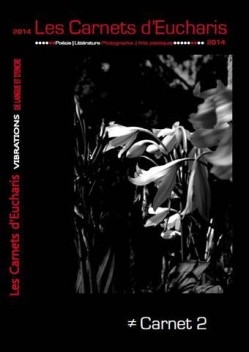 Le premier numéro des Carnets d’Eucharis (dans sa version papier), revue animée par Nathalie Riera, a paru en février 2013.
Le deuxième est à paraître en 2014.
*
A propos de la revue, lire également cet article
“L’événement est à marquer d’une pierre blanche. Ces dernières années, on voyait surtout des revues qui passaient – étaient contraintes de passer – de l’état papier à l’état virtuel. On s’est presque habitué à tourner des pages qui n’avaient aucune réalité palpable, même si la machine, par excès de zèle, imite parfois le bruit ! La littérature, l’écrit, en voie de dématérialisation : la chose avait, a toujours, de quoi nous alarmer. Là, c’est l’inverse : le papier a une consistance, une odeur. On respire mieux soudain.”
(Patrick Kéchichian, Ent’revues, octobre 2013)
*
Posted by Paul Stubbs on November 20, 2013
https://blackheraldpressblog.wordpress.com/2013/11/20/a-propos-des-carnets-deucharis/

W.S. Graham, late 1950s
“La poésie de Graham est l’expérience intime d’une solitude éblouie par les rayons lunaires, une aventure d’être qui se mène, pour se faire jour à elle-même, dans la nuit de la conscience. Combien de poèmes aux accents rimbaldien de bateau ivre, de déluge et de voyance insatisfaite ou avortée, évoquent le thème de la pêche nocturne? Un motif qu’il tire vraisemblablement de sa propre expérience de marin. La mer et la nuit, associées à de multiples reprises, font même figures de parents symboliques : ainsi de la nuit«qui [l]e nomme jusqu’à l’os» et de la mer «qui [l]e prononce». Dans ces moments de silence et de lumière paradoxale, où le temps se suspend – temps mort où l’œil et la seconde s’écarquillent – , on le voit sonder les abysses de l’expérience esthétique, traquant«l’euphorie d’être vivant dans le langage.» La figure romantique du marin affrontant «les embruns de son esprit» et les «paquets hurlants d’écume», devient à ses yeux la métaphore exacte du poète. Poète, celui qui brave la tempête et tutoie la noyade, repoussant les limites de l’être, tout à la fois Ulysse, Sisyphe et Orphée exorcisant indéfiniment sa propre mort dans l’écriture” (Romain Verger, L’Anagnoste, novembre 2013)
*
LES DIALOGUES OBSCURS
W.S. GRAHAM
Poèmes choisis
traduit de l’anglais par Anne-Sylvie Homassel & Blandine Longre
Introduction de Michael Snow / Postface de Paul Stubbs, recueil bilingue
Black Herald Press, Septembre 2013
174 pages – 14 € / £ 12 / $18 / ISBN 978-2-919582-07-5
commander l’ouvrage / order the book
*
Posted by Paul Stubbs on November 19, 2013
https://blackheraldpressblog.wordpress.com/2013/11/19/des-mots-noyes-lances-dans-le-noir-w-s-graham-article-de-romain-verger/
“Le poète se remarque à la quantité de pages insignifiantes qu’il n’écrit pas. Il a toutes les rues de la vie oublieuse pour distribuer ses moyennes aumônes et cracher le petit sang dont il ne meurt pas.”
René Char (À une sérénité crispée, 1952)
Posted by Paul Stubbs on November 16, 2013
https://blackheraldpressblog.wordpress.com/2013/11/16/toutes-les-rues-de-la-vie-oublieuse/
 “vous êtes le souvenir ou le fantasme d’un passé légendaire, d’une réalité sans fond, d’un présent sans lien : en musique, tristement, dans l’errance de l’espèce”
Jean-Baptiste Monat (Cavales, 2013)
*
*
Cavales
Jean-Baptiste Monat
Editions Hochroth Paris, 2013
http://www.paris.hochroth.eu/fr/3117/cavales/
*
Un article de Jean-Pierre Longre
http://jplongre.hautetfort.com/archive/2013/10/21/mots-en-fuite-5201605.html
L’homme sans réseaux
http://lhommesansreseaux.hautetfort.com/
*
Posted by Paul Stubbs on November 14, 2013
https://blackheraldpressblog.wordpress.com/2013/11/14/cavales-jean-baptiste-monat/

William Sydney Graham by Michael Seward Snow, late 1950s
“L’ouverture et l’élargissement du travail poétique sont d’ailleurs revendiqués par Graham lui-même, dans ses « Notes sur une poésie de la libération » ici reproduites. Pour lui, « le poème est plus que l’intention du poète ». « Pour chaque individu il prend une vigueur nouvelle. C’est le lecteur qui le ramène à la vie et il participe à la transformation du lecteur ».
Fort de ces considérations, et de la présentation faite par Michael Snow (ami du poète, décédé trop tôt pour voir cette parution), le lecteur peut pénétrer dans le monde de W. S. Graham, se glisser peut-être « entre moi et cet environnement qui m’envahit de toute part », et composer avec l’apparente obscurité (que le titre du recueil ne dément pas) de certains textes, qui conduisent « de l’autre côté / Du langage ». Il s’agit d’être à l’écoute (« Je laisse ceci à ton oreille pour quand tu t’éveilleras »), de savoir être « réceptif »” (Jean-Pierre Longre)
*
LES DIALOGUES OBSCURS
W.S. GRAHAM
Poèmes choisis
traduit de l’anglais par Anne-Sylvie Homassel & Blandine Longre
Introduction de Michael Snow / Postface de Paul Stubbs, recueil bilingue
Black Herald Press, Septembre 2013
174 pages – 14 € / £ 12 / $18 / ISBN 978-2-919582-07-5
Posted by Paul Stubbs on November 12, 2013
https://blackheraldpressblog.wordpress.com/2013/11/12/de-lautre-cote-du-langage-w-s-graham-lecture-de-jean-pierre-longre/
 “All of his life Cioran negated, if not banished, the idea of building for himself a philosophical ‘system’, realizing at an early age that the universe was too far imperturbable to be reduced to man’s own mortification. In his essay ‘Valéry Facing his idols’ he wrote: ‘if we were to translate the philosophers’ lucubrations into normal language, what would be left of them?’ Such premonitions reduced Cioran’s own mind to the size and space of a ‘confessional-box’, an unsolicited and shameless disclosure of who he really was. Each word, a drop of blood, reflected his unnameable lassitude, the inexhaustible sameness of his voice, his always private predilections for nothing but his own interior world-shapes. For this writer there was no difference between the detonation of a bomb and that of a full-stop: he accepted everything, his life a constant ‘new’ death entering into the graveyard of his speech. To live separate from the rest of mankind is not to be a destroyer of worlds, but of the spleen, he who in disparaging human beings acted upon a scarcely credible stage. Each aphorism in The Temptation to Exist for example is a far too-recent disaster, an ethical impasse, where inside each word we hear only a teleological clock ticking, and where the ancient ‘Rules’ and laws of matter have begun to subside in the dust of his own brain.” (Paul Stubbs)
*
Posted by Paul Stubbs on November 11, 2013
https://blackheraldpressblog.wordpress.com/2013/11/11/an-essay-on-the-writings-of-e-m-cioran-by-paul-stubbs/
“It is a good direction to believe that this language which is so scored and impressed by the commotion of all of us since its birth can be arranged to in its turn impress significantly for the good of each individual. Let us endure the sudden affection of the language.”
W.S. Graham, ‘Notes on a Poetry of Release’
“C’est une bonne direction, celle qui consiste à croire que ce langage, depuis sa naissance si marqué, si creusé par notre brouhaha collectif, peut être disposé de manière à laisser à son tour une impression significative pour le bien de chaque individu. Souffrons donc l’affection subite du langage.”
W.S. Graham, “Notes sur une poésie de la libération”.
(traduction Anne-Sylvie Homassel)
extrait de Les Dialogues obscurs, poèmes choisis, W.S. Graham (Black Herald Press, 2013)
excerpt from The Dark Dialogues, selected poems, W.S. Graham (Black Herald Press, 2013)
http://blackheraldpress.wordpress.com/books/les-dialogues-obscurs-the-dark-dialogues-w-s-graham/
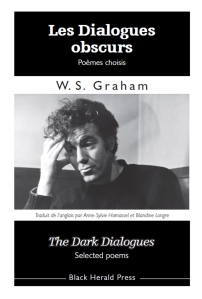
Les Dialogues obscurs
Posted by Paul Stubbs on November 10, 2013
https://blackheraldpressblog.wordpress.com/2013/11/10/souffrons-donc-laffection-subite-du-langage/

From Stone This Running – Heller Levinson, Black Widow Press
An essay by Paul Stubbs.
“So, to become a reconstructor of the universe, ‘Hinge’ must seek to translate into outer music the inner music of words, to silence art and render physics and religion once again into the great early dreams of man; to induce an ongoing and perpetually fecund state of the anathemas that will help Levinson aspire to his new literary role of syntactical demiurge. It will be a quite necessary act of madness, an attempt certainly to achieve what Paul Valery imagined of Mallarmé’s task, i.e. ‘to raise a page to the power of the starry heavens.’ Levinson then assigns himself to the task of realizing the impossible, to conceive of failure as the only captivating success, and to hallucinate himself into the only obsession worth pursuing, that of locating the only true literary fracture at the earth’s crust, i.e. our belonging .To abort the self, in mid-sentence, is for the writer of ‘Hinge’ to celebrate the requirements of abortion, to complete what demands of itself to be undermined by words. ‘Hinge’, a catalogue and impulse of an always unforeseen matrix disengages itself long enough for us to snag ourselves on our own thoughts.” (Paul Stubbs)
*
*
Posted by Paul Stubbs on November 8, 2013
https://blackheraldpressblog.wordpress.com/2013/11/08/about-heller-levinsons-hinge-theory/
“on énumère jusqu’au miracle.
on arrache l’infini à ce qui plus tôt
advint et fut nommé.”
*
Plusieurs poèmes de Jos Roy à lire dans les numéros 2 et 3 du Black Herald.
http://blackheraldpress.wordpress.com/2012/09/15/jos-roy-poemes-poems/
Posted by Paul Stubbs on November 7, 2013
https://blackheraldpressblog.wordpress.com/2013/11/07/on-enumere-jusquau-miracle/

Anthony Vivis
Obituary of Anthony Vivis (1943-2013) in The Guardian.
“Anthony Vivis, who has died suddenly aged 70, was a renowned translator of postwar German plays that habitually documented mythical misery in the urban jungle while relating to the ingrained tradition of Brecht, Georg Büchner, Gerhart Hauptmann and Schiller.”
*
Anthony co-translated (with Will Stone) poems by August Stramm, published in the 3rd issue of The Black Herald.
http://blackheraldpress.wordpress.com/2012/09/12/august-stramm-four-poems-quatre-poemes/
*
“In memory of Anthony Vivis (1943-2013) theatrical writer, translator of German literature, friend and thoroughly decent man, who recently left us. The contribution Anthony made to English culture through forty years of translating German drama cannot be underestimated. His plays by writers such as Jelinek, Kroetz, Fassbinder and Brecht were performed in London’s West End and elsewhere, he worked for the BBC and the Royal Shakespeare Company and was a fellow of Clare College Cambridge. Anthony was one of the ‘old guard’ in German studies in and around UEA and was a long standing friend of both WG Sebald and Michael Hamburger. In a way in his more retiring capacity, he constituted the third part of this triumvirate who did so much for the reception of German letters in the UK. He will be sorely missed.” (Will Stone)
Posted by Paul Stubbs on November 6, 2013
https://blackheraldpressblog.wordpress.com/2013/11/06/anthony-vivis-1943-2013/
3 poems by Paul Stubbs have been published in the 3rd issue of SPOLIA magazine

© Paul Stubbs
(the PDF can be downloaded for 5 $)

Posted by Paul Stubbs on November 5, 2013
https://blackheraldpressblog.wordpress.com/2013/11/05/poems-by-paul-stubbs-spolia-issue-3/

Feersum Endjiinn
“Qu’est-ce que Feersum Endjiinn ? Un grand roman, bien sûr. Une œuvre cruelle autant que ludique pour tout traducteur – rendons ici hommage à Anne-Sylvie Homassel qui s’attela à traduire les étonnants et drolatiques monologues intérieurs de Bascule, enfant têtu et Raconteur de génie.”
(Jean-Luc A. d’Asciano, Directeur des éditions L’Œil d’or , sur D-Fiction)
http://d-fiction.fr/2013/07/feersum-endjinn/
*
*
*
EFROYABL ANGE1
Iain M. BANKS
Traduit de l’anglais par Anne-Sylvie Homassel
Illustrations Frédéric Coché
L’Oeil d’or, 2013
Posted by Paul Stubbs on November 4, 2013
https://blackheraldpressblog.wordpress.com/2013/11/04/efroyabl-ange1-de-iain-m-banks-vu-par-son-editeur/

The Violet Blood of the Amethyst
Louis Calaferte’s The Violet Blood of the Amethyst (Le Sang violet de l’améthyste) is now available, for the first time in English
Translated from the French and introduced by John Taylor.
bilingual book
Chelsea Editions, 2013
To order the book
http://www.chelseaeditionsbooks.org/Calaferte.htm
*
*
Excerpts were published in the 3rd issue of The Black Herald (Sept. 2012)
More excerpts here
Avance vers tes contraires. Édifie-toi protestataire contre ce qui te porte, te soutient, t’enlève à toi-renême. Fais-toi indivisible subtilité, approfondissement de la connaissance. Entre dans la partie resérvée du monde. Tu n’es admis qu’à la parcellisation. Qu’elle te devienne bien inaliénable. Partie du monde tienne, de ton unique éclairement, à ta seule ressemblance. Instaure-toi découverte et, de la sorte, conçois tes approches, tes encerclements. Consacre-toi à ton isolement. Point tant ne s’agit de grandeur que d’etendue.
Head toward what is contrary to you. Build yourself up by protesting what carries you, supports you, removes you from yourself. Make yourself into indivisible subtlety, deepening knowledge. Enter the private part of the world. You are admitted only to the parceling out. May your part become an inalienable good for you. A part of your own world, of your unique illumination, resembling you alone. Institute yourself as discovery and, in that way, plan your approaches, your encirclements. Devote yourself to your isolation. Greatness is much less the matter than vastness.
Posted by Paul Stubbs on November 3, 2013
https://blackheraldpressblog.wordpress.com/2013/11/03/louis-calafertes-the-violet-blood-of-the-amethyst/
“Challenging concepts, developed into a project-length exploration. A rarity in contemporary poetry; even the experimental scene is patchier in these than it should be. Paul Stubbs’ poetry is full of such ambition–pursued with a terrifying metaphysical and theological energy. It comes from an almost forgotten (and intensely unfashionable) idea of poetry as the threshold, the outer limit, for linguistic exploration of self and existence. The war-zone between transcendence and decay: metaphysical, ontological, eschatological. (…) The usual English comparisons simply don’t apply. No post-ironic surrealism, no still-born ‘experiments in form’, no drip-dry epiphanies by tremulous yet sickly seers. Even Hill seems less intense – almost anecdotal – in comparison. It may sound absurd, but Milton is the only English reference I can make – even then, there’s no narrative element in Stubbs. But the poem’s almost symphonic opening reminded me of Lucifer’s (and co-conspirators’) devastated awakening, the stumbling slow dawn of the fallen angels.”
(Paul Sutton, Stride Magazine)
*

Flesh
Flesh
Paul Stubbs
introduction by Ingrid Soren
Black Herald Press, May 2013
130×170 – 54 pages – 10 € / £ 8.50 / $13
ISBN 978-2-919582-05-1
Posted by Paul Stubbs on November 2, 2013
https://blackheraldpressblog.wordpress.com/2013/11/02/flesh-by-paul-stubbs-reviewed-by-paul-sutton/
The Black Herald
Literary magazine – Revue de littérature
Issue #4 – October 2013 – Octobre 2013
164 pages – 15€ / £12.90 / $20 – ISBN 978-2-919582-06-8 (ISSN 2266-1913)
Poetry, short fiction, prose, essays, translations.
Poésie, fiction courte, prose, essais, traductions.
With / avec Steve Ely, Pierre Cendors, Edward Gauvin, Paul B. Roth, Jean-Pierre Longre, Rosemary Lloyd, Boris Dralyuk, Paul Stubbs, Georgina Tacou, John Lee, Cristián Vila Riquelme, Philippe Muller, Michael Lee Rattigan, Desmond Kon Zhicheng-Mingdé, Vasily Kamensky, David Shook, Oliver Goldsmith, Michel Gerbal, Gary J. Shipley, Anthony Seidman, Fernando Pessoa, Cécile Lombard, Anne-Sylvie Salzman, Heller Levinson, Jorge Ortega, Blandine Longre et des essais sur / and essays about Robert Walser, Arthur Rimbaud, Raymond Queneau, E.M. Cioran. Images: Raphaël Lugassy, Pierre Cendors. Design: Sandrine Duvillier.
*
*

Posted by Paul Stubbs on November 2, 2013
https://blackheraldpressblog.wordpress.com/2013/11/02/the-black-herald-4-2013/

Les Dialogues obscurs
Un article de Nathalie Riera.
“Pour écrire, il y a des lumières et des obscurités à emprunter de tous côtés, des dialogues à saisir, qui nous parlent d’Etre et de non-être, peut-être pour nous inciter à davantage de rêveries, de relâchements. Ces dialogues obscurs n’ont rien de mystique : ils nous laissent entrevoir une autre dimension de nous-mêmes, issus d’un ici et maintenant non dénué de singularité. La poésie ne doit pas rester parmi les mots. Elle doit emprunter au monde réel, et non au rempart de la pensée conceptuelle.” (Nathalie Riera)
*
LES DIALOGUES OBSCURS
W.S. GRAHAM
Poèmes choisis
traduit de l’anglais par Anne-Sylvie Homassel & Blandine Longre
Introduction de Michael Snow / Postface de Paul Stubbs, recueil bilingue
Black Herald Press, Septembre 2013
174 pages – 14 € / £ 12 / $18 / ISBN 978-2-919582-07-5
Posted by Paul Stubbs on November 2, 2013
https://blackheraldpressblog.wordpress.com/2013/11/02/les-dialogues-obscurs-de-w-s-graham-lecture-de-nathalie-riera/

Gregory Corso

Anne-Sylvie Salzman

W.S. Graham

Blandine Longre

Jos Roy
Paul Stubbs

The Black Herald 4

The Black Herald 3

The Black Herald 2

The Black Herald 1
 Black Herald Press - BLOG